


Best Ecommerce Fulfillment Services for Seasonal Ecommerce Brands
Seasonal brands don't get a second chance at peak season. One fulfillment breakdown during Q4 can wipe out months of margin. Ecommerce fulfillment services that work fine under normal conditions often buckle when order volume triples overnight, inventory accuracy slips, and shipping costs spike without warning. After reviewing dozens of 3PL providers across fulfillment capacity, carrier partnerships, and warehouse certifications, it's clear that not all options are built for brands that live and die by seasonal spikes. This guide covers the five providers worth your attention.
How this ranking was put together
Every option on this list was researched using publicly available sources, including verified client reviews, company websites, third-party directories, and real-world case studies. Only providers with a demonstrated track record in ecommerce logistics made the cut, with particular weight given to how each handles volume surges, inventory management, and order accuracy.
→ See the full research breakdown
- Ops Engine - Best for DTC brands and omni-channel retailers seeking personalized 3PL fulfillment
- ShipMonk - Best for ecommerce order fulfillment and 3PL logistics
- Ship Fusion - Best for ecommerce fulfillment and 3PL logistics
- Rakuten Super Logistics - Best for ecommerce fulfillment and order management
- Red Stag Fulfillment - Best for enterprise and fast-growing ecommerce brands handling big, heavy, and bulky products
Why Ecommerce Fulfillment Services Are Worth a Closer Look
Picking the wrong fulfillment partner costs more than just money. It costs customer trust, and during peak season, that trust is nearly impossible to rebuild quickly.
Seasonal brands face a specific kind of pressure: managing inventory accuracy across dozens of SKUs and multiple warehouse locations while absorbing unpredictable shipping cost increases from major carriers. A 3PL that isn't built for those realities will struggle when it matters most.
The right fulfillment partner brings real operational depth that translates directly into measurable outcomes: a higher order accuracy rate, a shorter order cycle time from placement to shipment, and an on-time shipping rate that doesn't fall apart during your busiest week. That combination is what separates a solid partnership from a costly mistake.
Comparing the 5 Best Ecommerce Fulfillment Services
Note: All data in this table is sourced from review platforms and the official websites of the listed companies.
Company Name
Years Operating
Headquartered In
Ops Engine
-
Valencia, CA, United States
ShipMonk
Est. 2014
Fort Lauderdale, FL
Ship Fusion
Est. 2013-2014
Toronto, Canada
Rakuten Super Logistics
Est. 2001
Las Vegas, NV
Red Stag Fulfillment
Est. 2013
Knoxville, Tennessee
- Ops Engine - Best for DTC Brands and Omni-Channel Retailers Seeking Personalized Fulfillment
What Services Does Ops Engine Offer?
Brands that need more than a generic warehouse relationship will find that Ops Engine covers the full fulfillment stack, including receiving, storage, picking, packing, and shipping, with real depth in work like kitting, assembly, returns management, and retail prep. What sets them apart is how they position their ecommerce fulfillment services for online stores around a personalized model rather than a volume-first approach. Their four-part scan verification system targets 99.99% order accuracy, which is exactly the kind of number seasonal brands need when every peak-season order counts.
Why Does Ops Engine Stand Out for Ecommerce Fulfillment Services?
Seasonal brands often suffer from fulfillment partners that treat them as low-priority accounts during surges. Ops Engine's dedicated account management model directly addresses that gap. From what the data shows, their transparent billing model and expansion to the East Coast signal a serious long-term commitment to the brands they serve.
Pricing
Ops Engine does not list a fixed rate card for its own services. Its pricing guidance explains that 3PL costs usually include receiving, storage, pick-and-pack, shipping, setup/integration, and value-added services, so brands should request an itemized quote based on order volume, SKU count, storage needs, and kitting or returns requirements.
What Users Are Actually Saying:
Testimonials on their website point to billing transparency and operational precision as the two things clients mention most. Honestly, for brands that have been burned by surprise fees and inaccurate orders from larger 3PLs, that combination lands well. The "Your Warehouse Department" positioning works well with DTC operators who want a partner, not just a vendor.
- ShipMonk - Best for Ecommerce Order Fulfillment and 3PL Logistics
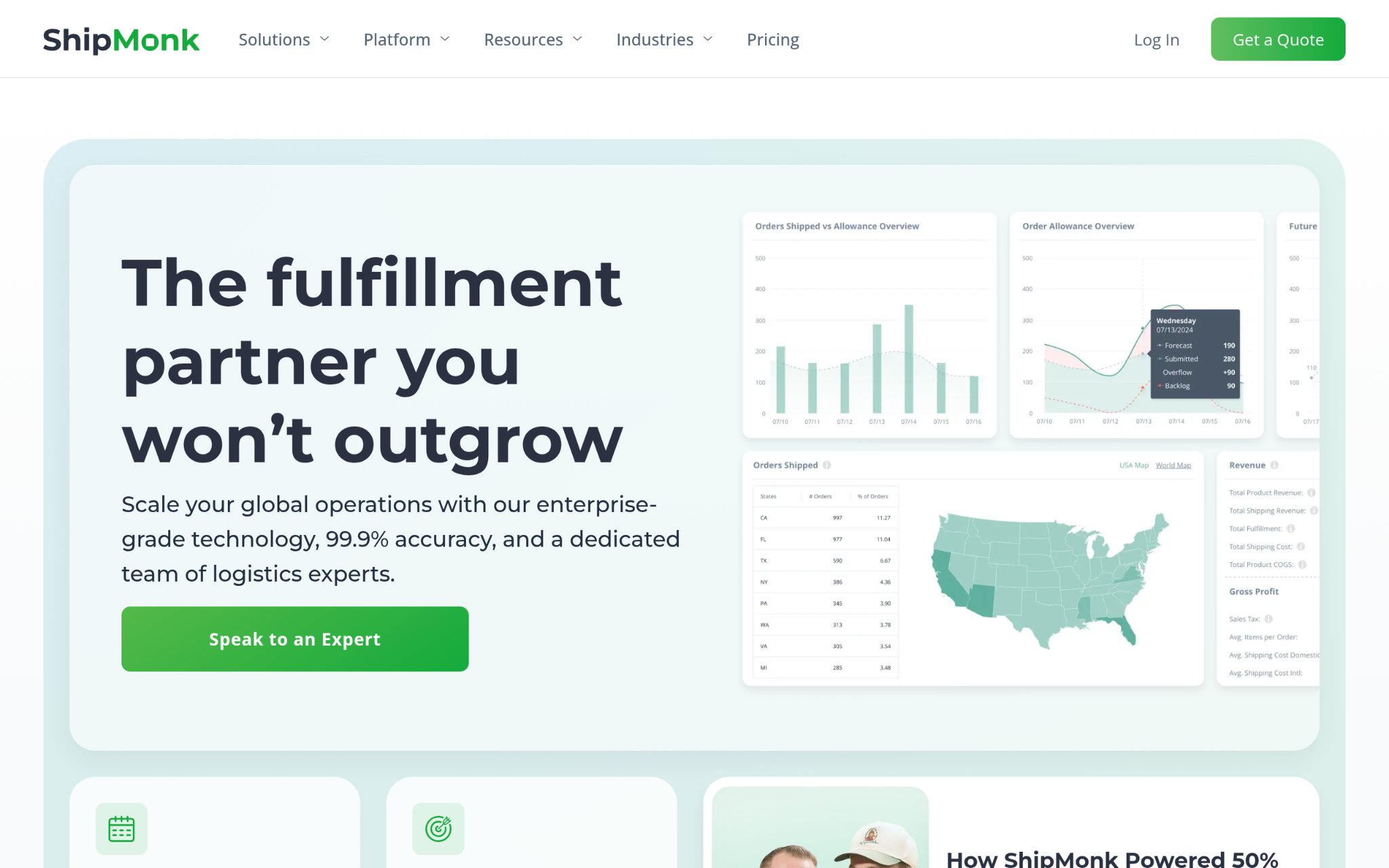
What Services Does ShipMonk Offer?
ShipMonk covers inventory storage, picking, packing, and shipping across 12 fulfillment centers in the US, Canada, Mexico, and Europe. Their warehouse management system handles high SKU counts and complex kitting, which makes them a strong option for brands managing product variety at scale. They target orders of 500 or more per month, so smaller brands might find they're not quite the right fit (think mid-market and up). Their 99.9% accuracy benchmark and cross-border reach make them worth a serious look for growing DTC and B2B retailers.
Why Does ShipMonk Stand Out for Ecommerce Fulfillment Services?
ShipMonk tackles the challenge of scaling fulfillment internationally without losing operational control, which is one of the hardest things to pull off in ecommerce logistics. That kind of multi-country infrastructure is rare among 3PLs at this price point. Their award history, including Business Intelligence Group's Company of the Year for three consecutive years, backs up the reputation.
Pricing:
ShipMonk uses a custom quote model. Its pricing page breaks fulfillment costs into areas such as storage, shipping, returns processing, lot control, gift messages, and monthly minimums, so brands should compare the full fee structure instead of only looking at the pick-and-pack rate.
What Users Are Actually Saying:
From what the reviews show, ShipMonk earns consistent praise for their platform's automation and the visibility it gives merchants into real-time inventory levels. Some users note that the setup process takes time to get right, but once the configuration is dialed in, the system runs well. The Deloitte Technology Fast 500 recognition gives prospective clients confidence they're working with a company that's growing for good reasons.
- Ship Fusion - Best for Ecommerce Fulfillment and 3PL Logistics
What Services Does Ship Fusion Offer?
Ship Fusion runs its own fulfillment centers (over 1 million square feet across North America and Asia), so it doesn't broker warehouse space to third parties. They cover order processing, inventory management, returns handling, and shipping, all tied together through their own proprietary software platform with real-time analytics. Every client gets a dedicated account manager, and pricing is customized with no hidden fees. Their SQF-certified US facilities and Health Canada-approved Toronto location make them a solid choice for regulated product categories.
Why Does Ship Fusion Stand Out for Ecommerce Fulfillment Services?
Owning their own warehouse infrastructure and running custom software puts Ship Fusion in a different position than most 3PLs that rely on third-party tools and leased facilities. Based on the research, that usually means faster problem resolution and more consistent performance metrics across locations, which matters a lot when you're managing inventory accuracy across multiple SKUs during a peak season crunch.
Pricing:
Ship Fusion uses customized pricing instead of a fixed public rate card. However, its pricing page shows recent sample quotes, with first-pick fees ranging from $1.36 to $1.52 and consecutive-pick fees ranging from $0.23 to $0.28, depending on the brand and monthly order volume. These should be treated as examples rather than guaranteed rates, so seasonal brands should request a quote based on SKU count, storage needs, order volume, packaging, and any special handling requirements.
What Users Are Actually Saying:
Ship Fusion's client results are well-documented. The Spiral Bible case study, where order volume jumped 211% while maintaining 99.9% accuracy, is the kind of proof point that builds real trust. Clients like TUSHY and Purity Coffee add name recognition that speaks to the quality of their operations. The Globe and Mail and Deloitte recognitions are a nice signal too (not just marketing awards, but business performance rankings).
- Rakuten Super Logistics - Best for Ecommerce Fulfillment and Order Management
What Services Does Rakuten Super Logistics Offer?
Rakuten Super Logistics runs a nationwide network of fulfillment centers built around a two-day delivery promise that reaches 98% of the US. They connect directly with major ecommerce platforms, including Shopify, Amazon, Magento, Walmart Marketplace, and eBay, through dedicated connections. Their SmartFill, SmartStock, and SmartShip tools give retailers more control over where inventory sits and how shipping costs are managed. For brands trying to compete on delivery speed without building their own infrastructure, this is a compelling setup.
Why Does Rakuten Super Logistics Stand Out for Ecommerce Fulfillment Services?
Covering 98% of the US within one to two days via ground shipping is a fulfillment speed benchmark that most 3PLs simply can't match with the same consistency. That kind of delivery network, combined with tight platform connections, directly supports the on-time shipping rates that seasonal brands depend on during their highest-volume windows.
Pricing:
Rakuten Super Logistics, now operating as ShipNetwork, uses custom pricing built around each client’s order volume, shipping profile, SKU mix, storage needs, and operational requirements. This makes it difficult to compare by headline price alone. Brands should ask for a full breakdown of fulfillment, storage, shipping, returns, kitting, and any add-on service fees before comparing it with other 3PL providers.
What Users Are Actually Saying:
Merchants who use Rakuten Super Logistics tend to point to the delivery speed and multi-platform connectivity as the standout features. The Rakuten brand name carries weight in the broader ecommerce ecosystem, which gives some clients added confidence in the partnership. From what the data shows, the proprietary tools get a lot of credit for helping brands reduce cost per order fulfilled as they scale.
- Red Stag Fulfillment - Best for Enterprise and Fast-Growing Brands Handling Big, Heavy, and Bulky Products
What Services Does Red Stag Fulfillment Offer?
Red Stag Fulfillment was founded by ecommerce operators, not logistics executives, and that background shows in how they're built. They cover DTC parcels and pallets, retail distribution, Amazon prep, kitting, bundling, and LTL shipping across two strategically located warehouses totaling 1.2 million square feet. Their performance guarantees include zero shrinkage and financial reimbursement for missed accuracy commitments. For brands selling big, heavy, or bulky items that most 3PLs struggle to handle well, Red Stag is one of the few operators with genuine depth here.
Why Does Red Stag Fulfillment Stand Out for Ecommerce Fulfillment Services?
Most third-party logistics providers are designed around standard parcel sizes, which leaves brands with oversized products scrambling for workarounds that add cost and slow down order cycle time. Red Stag's founder-owned, no-venture-capital model means their incentives stay aligned with client outcomes rather than investor growth metrics. And that kind of alignment tends to produce more reliable fulfillment performance over time.
Pricing
Red Stag Fulfillment’s pricing is personalized, especially because the company focuses heavily on large, heavy, bulky, and high-value products. Public pricing summaries list onboarding at $0, receiving at $14.25 per pallet or $6 per non-pallet package, storage at $0.75 per cubic foot, pick-and-pack at $1.80–$2.25 for the first item plus $0.32 per additional item, packaging from $0.80, returns at $6 per order, and special projects at $40 per man-hour. Since these rates can vary by product type and volume, brands should still request a direct quote before making a final decision
What Users Are Actually Saying:
Red Stag holds a 98% overall rating on WebRetailer and has appeared on Fit Small Business's Best 3PLs for Small Businesses list six years in a row. That kind of consistent recognition across years is harder to fake than a single award cycle. The Pop-A-Shot success story (200x sales growth) and clients like Oatly and Concept2 show they can handle both niche brands and serious scale.
Methodology Behind These Picks
Gathering Information for Your Analysis
Building the longlist started with a broad sweep across 3PL directories, fulfillment-specific review platforms, and industry publications. Providers were pulled from multiple sources rather than relying on any single database, which helps reduce the bias that comes from ranking within a single platform's ecosystem. Company websites were reviewed for service pages, case study documentation, and any published operational benchmarks. The goal at this stage was breadth, not filtering, so as many credible candidates as possible were brought into the pool before evaluation began.
The Shortlist Cut
From that broader pool, options were removed if they lacked verifiable operational data or if their review patterns showed inconsistency across platforms. Providers with a thin public presence, no documented client results, or review histories that looked artificially inflated didn't make the cut. The shortlist was narrowed by looking for 3PLs with clear service differentiation, documented accuracy metrics, and meaningful client representation across different product types and order volumes.
Fact-Checking the Picks
Every claim pulled from a company's own website was cross-referenced against external sources where possible. If a provider advertised a 99.9% order accuracy rate, that figure was checked against client testimonials and third-party review summaries to see if real-world feedback aligned with the marketing language. Providers where self-reported metrics and actual client experience showed wide gaps were deprioritized. The goal was to only include companies where the story told on their website roughly matched what clients described when using the service.
Authority Signals and Industry Standing
Award recognition, appearances in business publications, and placement on recognized growth lists were factored in as supporting signals. These aren't the most important criteria, but they do help distinguish providers with genuine industry standing from those with polished marketing. Recognition from sources like Deloitte's Technology Fast 500, Globe and Mail's Report on Business rankings, Inc. 5000 placements, and Fit Small Business's annual 3PL lists were treated as meaningful indicators of sustained performance rather than one-off moments.
Ecommerce Fulfillment Services Track Record
Each provider's track record in ecommerce fulfillment was reviewed through their dedicated service pages, the specificity of their case studies, and the types of clients they've publicly worked with. Generic logistics companies that also offer fulfillment as a side service were excluded in favor of providers where ecommerce fulfillment is clearly what they focus on. Case studies that included measurable outcomes, like documented order volume growth with maintained accuracy, were given more weight than general testimonials without supporting numbers.
Picking the Right Ecommerce Fulfillment Services for You
Choosing a fulfillment partner isn't just about warehouse location or price per order. The right fit depends on how well a provider's operational strengths match your brand's specific growth stage, product profile, and seasonal demand pattern. Here are the factors worth weighing before you commit.
- Industry and Domain Experience: Look for providers with documented experience in your product category. A 3PL that handles standard parcels well may struggle with fragile, oversized, or regulated items, especially during peak season surges.
- Features and Service Options: Go beyond pick-and-pack basics. Kitting, retail prep, returns management, and real-time inventory visibility can make or break your operational flexibility when order volume scales quickly.
- Pricing Structure: Transparent, customized pricing matters more than the lowest headline rate. Hidden fees around receiving, returns, or special handling add up fast during high-volume periods, when you're least able to absorb them.
- Results Measurement: Ask every provider how they track and report on order accuracy rate, order cycle time, and on-time shipping rate. If they can't show you historical benchmarks, that's a gap worth noting.
- Industry Knowledge and Carrier Compliance: Providers familiar with carrier compliance and customs requirements will handle volume spikes and cross-border complexity without creating delays that damage customer trust.
The Verdict
Picking the right fulfillment partner comes down to fit: product type, order volume, shipping zones, pricing structure, and the level of support the brand needs. ShipMonk is a strong fit for larger merchants that need enterprise-level systems. Deliverzen works well for beauty, skincare, and supplement brands that need careful handling and hands-on support. Ops Engine is better suited to DTC brands with kitting, returns, and retail prep needs. Ware2Go fits merchants looking for flexible warehousing and distributed fulfillment. Rakuten Super Logistics is more relevant for brands prioritizing network reach and delivery speed. As ecommerce order volumes grow, comparing both service quality and total fulfillment cost becomes more important.
Sources used for pricing direction: the uploaded article structure and provider sections, plus public pricing/quote pages for the listed providers. Ops Engine explains common 3PL pricing components, Deliverzen and ShipMonk present custom/quote-based pricing, Ware2Go pricing is described as quote-based in current summaries, and ShipNetwork/Rakuten pricing is not publicly disclosed.
